Student Loan Repayment Plans: How to Choose the Right One for Your Finances
One of the most consequential financial decisions you'll make after graduation is choosing a student loan repayment plan. The plan you select determines your monthly payment, how much interest you'll pay over time, and whether you qualify for federal loan forgiveness. With several repayment options available—from the standard 10-year schedule to income-driven plans that cap payments based on your earnings—there is no single best choice. Your optimal plan depends on your income, loan balance, career goals, and tolerance for long-term debt. This comprehensive guide explains each major federal student loan repayment plan, highlights their advantages and drawbacks, and gives you a practical framework for selecting the plan that fits your situation.
Standard and Graduated Repayment Plans
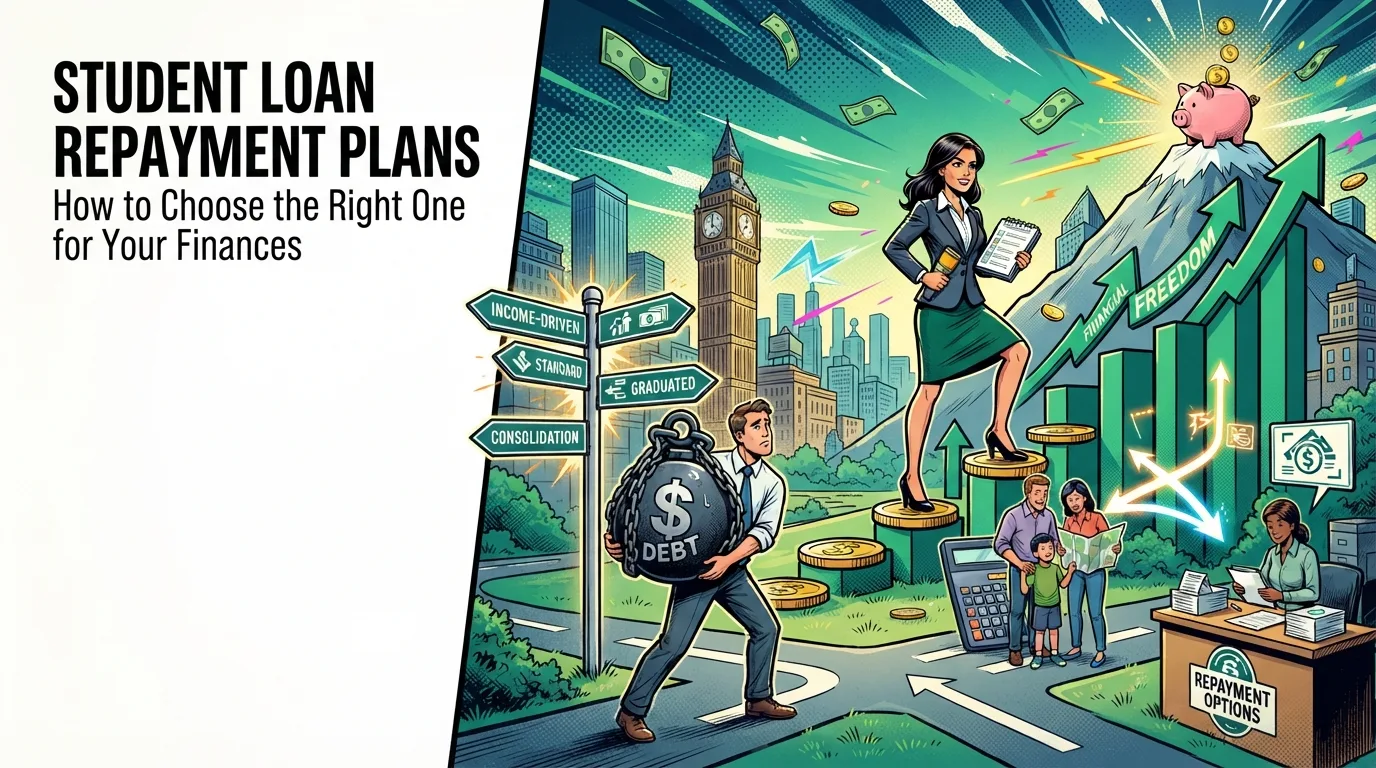
These are the two most straightforward repayment plans, and both are designed to pay off your loan within 10 years (or up to 30 years for consolidated loans, depending on balance).
- Standard Repayment Plan. You pay a fixed amount each month for 10 years. This plan results in the highest monthly payment but the lowest total interest paid. For example, a $30,000 loan at 5.5% interest would require about $325 per month and cost roughly $9,000 in total interest.
- Graduated Repayment Plan. Payments start lower—often just covering interest—and increase every two years. The loan is still paid off in 10 years, but your monthly payment can rise to amounts above the standard plan later on. You will pay more overall interest than with the standard plan (about 10% to 20% more), but the early payment relief can help when you are just starting your career.
Both plans are available for all federal student loans (except some parent PLUS loans if consolidated). There is no income requirement. If you can comfortably afford the standard payment, that is usually the smartest financial move because you become debt-free quickly and minimize interest charges. A graduated plan makes sense if you anticipate income growth and need a reduced payment in the first few years—but carefully assess whether you will be able to handle the later increases.
Extended Repayment Plans
If you have more than $30,000 in outstanding federal student loan debt, you are eligible for an extended repayment plan. This plan stretches your payments over 25 years, offering two options:
- Extended Fixed. Payments remain level for the entire 25-year term.
- Extended Graduated. Payments start low and increase every two years, with the loan still paid off after 25 years.
The main benefit is a substantially lower monthly payment. For a $40,000 loan at 6% interest, the standard 10-year payment would be around $444 per month. The extended fixed plan would drop that to roughly $258 per month—a 42% reduction in cash flow. However, the long term dramatically increases interest costs. On that same $40,000 loan, the standard plan would generate about $13,300 in total interest, while the extended plan would accrue more than $37,300 over 25 years. That's a staggering difference.
Extended repayment plans are not qualifying repayment plans for Public Service Loan Forgiveness (PSLF), because only the 10-year standard plan or an income-driven repayment (IDR) plan count toward the 120 required payments. If you think you may work in public service, avoid the extended plan unless you know you won't need PSLF.
Income-Driven Repayment Plans
Income-driven repayment (IDR) plans were designed to keep monthly payments manageable when your income is low relative to your debt. Your payment is calculated using your discretionary income—the difference between your adjusted gross income and a multiple of the federal poverty line—and your family size. After 20 or 25 years of qualifying payments, any remaining balance is forgiven. Here are the four main IDR plans:
- Income-Based Repayment (IBR). For new borrowers (after July 1, 2014), payments are 10% of discretionary income, capped at the 10-year standard payment. Older borrowers pay 15%. Any remaining balance is forgiven after 20 years for new borrowers, or 25 years for older ones.
- Pay As You Earn (PAYE). Payments are 10% of discretionary income, never exceeding the standard payment. You must be a new borrower (no federal loans before Oct. 1, 2007) and have a partial financial hardship. Forgiveness comes after 20 years.
- Income-Contingent Repayment (ICR). Payments are the lesser of 20% of discretionary income or a fixed payment over 12 years adjusted for income. This plan is available to all Direct Loan borrowers, regardless of financial hardship. Forgiveness occurs after 25 years. ICR is the only IDR plan available for Parent PLUS loans (after consolidation).
- Saving on a Valuable Education (SAVE) Plan. Launched in 2023, this was intended to be the most generous IDR plan. It calculated payments based on 10% of discretionary income, but used 225% of the poverty line (instead of 150%) and offered forgiveness after as few as 10 years for borrowers with smaller balances. However, the SAVE plan is currently blocked by federal court rulings. Borrowers enrolled in SAVE have been placed in interest-free forbearance. Because of this litigation, you should check the latest status with your loan servicer or StudentAid.gov before choosing SAVE.
How IDR payments compare to standard payments
| Plan | Typical Payment (for $40,000, single borrower, $45,000 income, family size 1) | Repayment Term | Forgiveness Window | |------|------|------|------| | Standard | $444 (fixed) | 10 years | None | | Extended Fixed | $258 (fixed) | 25 years | None | | PAYE/IBR (new) | Roughly $200 (10% of discretionary income) | 20 years | After 20 years | | ICR | Roughly $270 (20% of discretionary income) | 25 years | After 25 years |
The table shows that IDR plans can significantly reduce monthly payments, but they require you to track your income and family size each year. If your income rises, so will your payment, though it typically stays capped at the standard amount. For many borrowers, the possibility of forgiveness is the biggest draw—especially those with high debt and modest income.
Loan Forgiveness Programs That Reward Specific Plans
Choosing a repayment plan that qualifies for forgiveness is critical if you work in the public sector or run a nonprofit.
- Public Service Loan Forgiveness (PSLF). This program forgives the remaining balance on your Direct loans after you make 120 qualifying payments while working full-time for a qualifying employer (government, 501(c)(3) nonprofit, etc.). Qualifying payments must be made under an IDR plan or the 10-year standard plan. To maximize forgiveness, borrowers in public service should usually pick the IDR plan with the lowest monthly payment, because the amount forgiven (the leftover balance) is tax-free under PSLF.
- Teacher Loan Forgiveness. If you teach for five consecutive years in a qualifying low-income school, you may qualify for forgiveness of up to $17,500 on your federal loans. This program does not require a specific repayment plan, but you must make all five years of payments on time. It interacts with PSLF in specific ways, so plan strategically if you might use both.
- Income-Driven Forgiveness. Even if you don't work in public service, IDR plans forgive your remaining balance after 20 or 25 years. The forgiven amount is considered taxable income, which can lead to a substantial tax bill in the year of forgiveness. Still, for borrowers with huge balances and low income, the eventual tax hit can be far less than trying to repay the full principal over a normal timeline.
These programs add a layer of complexity but can change the cost-benefit calculus of which plan you choose. Always run the numbers with your actual loan balances and expected career trajectory before deciding.
How to Choose the Right Repayment Plan
Selecting a repayment plan isn't a one-size-fits-all exercise. Use this step-by-step approach:
- Check your loan types and balances. First, log in to StudentAid.gov to see exactly what you owe and which federal loan types you have. Private loans are not eligible for these federal plans.
- Decide if forgiveness is a goal. Are you in (or planning to enter) public service? Do you expect to have debt after 20+ years? If yes, an IDR plan is almost certainly the right fit. If no, your priority is likely minimizing total interest.
- Calculate your budget. If the standard payment is affordable and you want to be debt-free fast, choose the standard plan. If you can't afford it, you need an IDR or extended plan. Use the Federal Student Aid loan simulator to compare exact numbers.
- Consider your income trajectory. If you're in a high-earning field and expect your salary to grow quickly, the graduated plan might give you early relief, but you'll pay more interest. Conversely, if your income remains low, an IDR plan will cap your payments and may lead to forgiveness.
- Reassess every year. Your financial situation changes, and so can your repayment plan. You can switch plans at any time, though some IDR plans require you to recertify income and family size annually. If you lose your job or have a medical emergency, contact your servicer immediately—you may qualify for a $0 payment on IDR or an emergency forbearance.
Example scenarios:
- Maria is a social worker earning $42,000 with $50,000 in federal student loans. She works for a county government. Under the standard plan, her payment would be $525—nearly 15% of her gross income. Instead, she chooses PAYE. Her monthly payment is about $210 after her deduction. After 10 years of qualifying payments under PSLF, she has her remaining balance forgiven tax-free.
- James is an engineer earning $90,000 with $60,000 in loans. He expects his salary to grow. He could lower his payment with PAYE, but because he doesn't plan to work in public service, the standard plan would have him debt-free in 10 years and save tens of thousands in interest. He chooses Standard Repayment.
Ultimately, there is no universal right answer. The best plan is the one that keeps you financially stable today without destroying your future wealth. Use the official tools, talk to your loan servicer, and make a deliberate choice.
Bottom Line
Your student loan repayment plan is one of the most powerful levers you have to shape your financial future. Standard and graduated plans are simple and quick but can strain your monthly budget. Extended plans offer relief but dramatically increase total interest. Income-driven repayment ties your payment to your earnings, provides long-term affordability, and can lead to forgiveness—particularly if you combine it with PSLF or remain on the plan for 20–25 years.
The right plan for you depends on your unique financial situation and career outlook. Start by reviewing your current federal loans at StudentAid.gov, use the official loan simulator to compare plans side by side, and revisit your decision at least once a year or whenever your income changes. A plan that is manageable today—and sustainable tomorrow—is the plan that will keep you on track toward financial progress.
Frequently Asked Questions
What is the difference between standard and income-driven repayment plans?
The standard plan uses fixed payments for 10 years, typically the highest monthly payment and lowest total interest. Income-driven repayment plans set your payment based on your income and family size, which can result in a lower monthly payment and potential loan forgiveness after 20–25 years, but you will likely pay more interest over time.
Can I switch repayment plans after I've started making payments?
Yes, federal student loan borrowers can change repayment plans at any time at no cost. Some restrictions apply, such as the need to recertify your income for IDR plans or to get your loan out of default before switching. Contact your loan servicer or use StudentAid.gov to request a change.
How do income-driven repayment plans affect my credit score?
Your repayment plan itself does not affect your credit score. As long as you make payments on time, IDR plans can actually help by keeping monthly payments affordable and reducing the chance of missed payments. Carrying debt over a longer period does not lower your credit score as long as your payment history remains strong.
References