Automatic Savings Tips: How to Set Up Savings That Run on Autopilot
Saving money consistently is one of the most reliable ways to build financial security, but it’s also one of the hardest habits to stick to. Between endless bills, subscription services, and the temptation to spend, even well-intentioned savers often fall short. In the Federal Reserve’s 2023 survey, 37% of U.S. adults said they would struggle to cover a $400 emergency expense without borrowing or selling something. That’s why automatic savings tips matter: they take decision-making off your plate. When saving is automatic, you don’t rely on willpower, memory, or motivation—you remove the obstacles that cause most people to fail.
Automated saving uses basic behavioral economics to your advantage. By choosing a specific system that moves money for you, you turn saving from an active choice into a default action. The following strategies will help you set up a savings engine that works in the background, so you can accumulate wealth without thinking about it every day.
Why Automatic Savings Is More Effective Than Willpower
Research shows that people tend to overweight immediate rewards and undervalue future benefits—a phenomenon called present bias. This is why promising yourself to 'save whatever is left at the end of the month' rarely works. Money left in a checking account is too accessible, and every purchase feels more urgent than an abstract future goal.
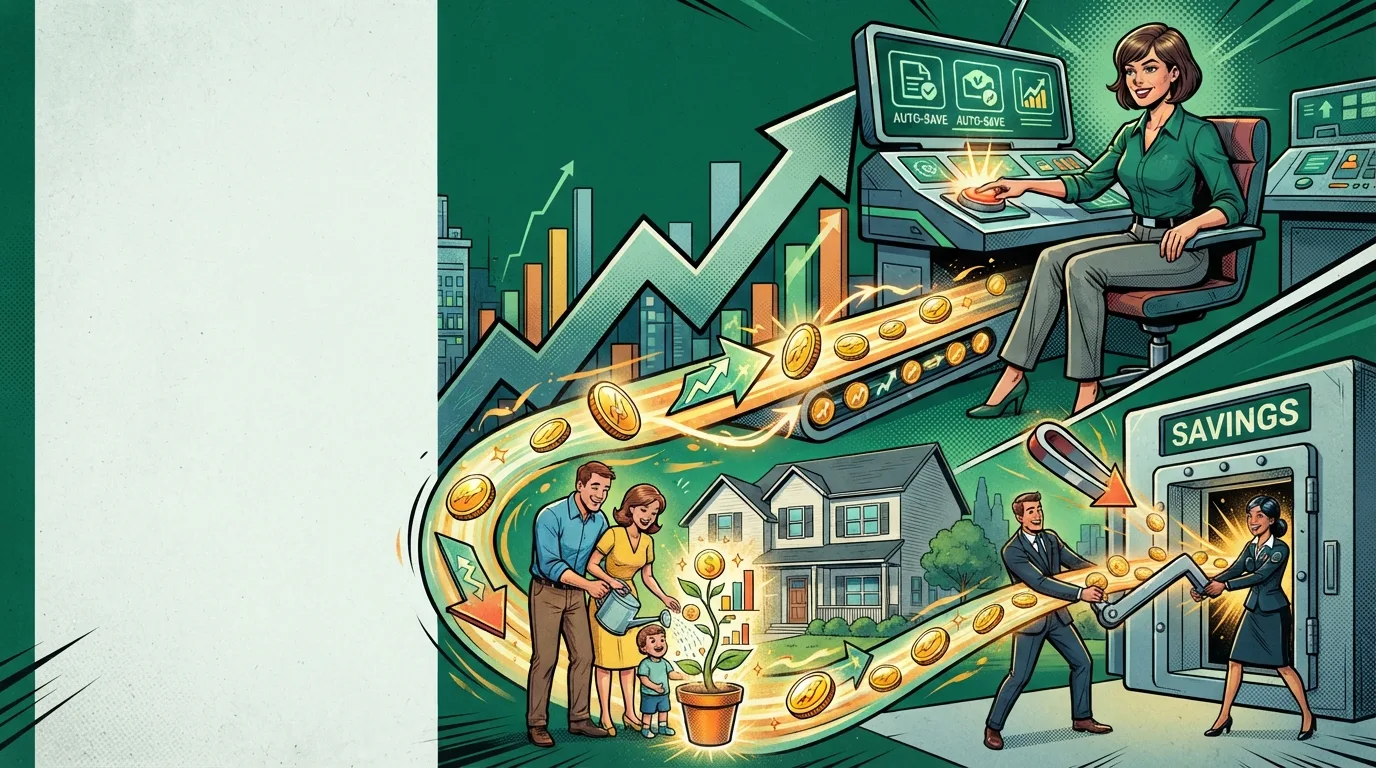
Automatic savings flips the script. Instead of saving whatever is left, you pay yourself first. This approach is built on the principle of commitment devices, first popularized by economist Richard Thaler. A commitment device restricts your future choices to align with your long-term goals. For example, a recurring transfer that moves $200 from checking to savings every payday means the money is gone before you can spend it.
Real-world data supports this. Before auto-enrollment in workplace retirement plans, many employees simply never joined, even though they could have gotten an employer match. When 401(k) contributions were made automatic, participation rates jumped from around 48% to over 86%, according to Vanguard’s analysis of retirement plans. You can replicate that same effect on a smaller scale with your personal savings accounts.
Set Up Recurring Transfers From Checking to Savings
The most straightforward automatic savings tip is to schedule a recurring transfer on the same day you get paid. Here’s how to get started:
- Choose a destination for your savings. A separate high-yield savings account (HYSA) is a smart option. It pays higher interest than a regular checking account and keeps your savings out of sight.
- Decide how much to transfer. If you’re new to automation, start with 1% of your pay and increase it by 1% each month until you reach 10–15%. Even small amounts build momentum.
- Pick the right transfer date. Immediately after payday is ideal. That way, the money arrives when your account is most likely to have a balance.
- Set it and review it. Most banks let you transfer funds instantly between your own accounts. You can set up a weekly, biweekly, or monthly recurring transfer.
For example, if you’re paid $2,000 biweekly, a 10% automatic transfer moves $200 into savings each payday. That adds up to $5,200 a year, plus any interest your savings account earns. With an annual percentage yield (APY) of 4% or more available today, your money grows even faster.
A key detail: make sure the transfer happens automatically, not manually. Manual transfers require willpower. If you have to log in and confirm, you’re back to relying on motivation. Set it and forget it—then check in quarterly.
Split Your Direct Deposit to Pay Yourself First
Another powerful method is to split your salary at the source. Many employers allow you to direct deposit your paycheck into more than one account. Instead of transferring money from checking to savings, ask your payroll department to send a fixed percentage or dollar amount directly to your savings account.
This approach has a critical advantage: the savings never appears in your checking account. You won’t see it, miss it, or overspend it. It is truly out of sight, out of mind.
To set this up:
- Contact your payroll or human resources team or log in to your employee self-service portal.
- Find the direct deposit update section.
- Add your savings account as an additional account and specify the amount or percentage.
- Keep your checking account as the primary account for the remainder.
For example, you could route $500 of a $2,500 biweekly paycheck to your HYSA and deposit the remaining $2,000 into checking. Your daily spending budget is now $2,000 per pay period, and you’re automatically saving 20%.
Direct deposit splitting also works well if you have irregular income from contract work. Although your income may vary, you can set a percentage rather than a fixed amount, ensuring you save a proportional share of every payment.
Automate Retirement and Investment Contributions
Employer-sponsored retirement plans are one of the easiest places to automate saving. A 401(k), 403(b), or SIMPLE IRA lets you deduct contributions directly from your paycheck, pre-tax (or post-tax, if it’s a Roth option). Because the deferral happens before you receive your wages, you don’t have a chance to spend it.
To maximize this:
- Contribute at least enough to earn the full employer match. A common match is 50% of the first 6% of your pay. If you earn $60,000 and contribute 6%, your employer would add $1,800 a year. That’s free money.
- Use auto-escalation. Many plans let you set an annual automatic increase of 1% or more. Vanguard found that auto-escalation raised default contribution rates from 4% to 15% over several years. That’s how you gradually move from 6% to 15% without feeling the pinch.
- If you don’t have a workplace plan, open an individual retirement account (IRA) or Roth IRA at a broker. Set up an automatic monthly transfer from your bank account—it’s the same principle, but you control the investment choices.
The tax benefits make these accounts even more powerful. Contributions to a traditional pre-tax account reduce your taxable income, so you’ll owe less in taxes now. You can often automate health savings account (HSA) contributions too, if you have an HSA-eligible high-deductible health plan. HSAs offer a triple tax advantage: deductible contributions, tax-free growth, and tax-free withdrawals for qualifying medical expenses.
Use Round-Ups and Micro-Savings Tools
If your budget is tight and even a dollar matters, round-up and micro-savings apps can help. These tools automatically round your purchases to the nearest dollar and deposit the difference into an investment or savings account. For example, if you buy a coffee for $3.75, the app sets aside $0.25.
Popular examples include:
- Acorns: Rounds up purchases and invests spare change in a diversified portfolio. It charges a monthly fee, starting around $3 per month, which may be high for small balances.
- Chime (or other neobanks): Offers a round-up feature that automatically transfers spare change from your debit card to a savings account.
- Many traditional banks now include round-up features in their mobile apps, so you may not need a third-party app.
Research suggests that round-ups can be an effective starting point for savers, but they rarely produce enough money to build substantial wealth. If you spend $2,000 a month on your card, the round-ups might add up to about $1,000 a year, depending on the distribution of purchase amounts. It’s a useful supplement, not a complete savings plan.
A more aggressive micro-savings tool is a percentage-based rule. For instance, a financial app could automatically transfer 10% of your pay to a separate account based on your income. These tools use algorithms to analyze your cash flow and estimate what you can safely save, which is especially valuable if your income fluctuates.
Automate Raises, Bonuses, and Windfalls
Most people treat raises and bonuses as extra income to spend. But a simple automatic rule can change that. The moment your salary increases, adjust your automated savings amount by the same percentage. For instance, if you get a 3% raise, increase your automatic transfer by 3% of your new gross pay. You’ll never see the increase in your checking account, so you’ll adjust your lifestyle without missing it.
For irregular windfalls like tax refunds, bonuses, or gift money, consider a standing rule: transfer 50% of any unplanned money directly to savings. Some banks let you set up an automatic notification that triggers when a large deposit lands, but you may need to take action manually. To make it automatic, you could set up a separate savings account and deposit the whole windfall there, then transfer a 'fun portion' back to spending if you choose.
Another approach is to use 'pay-yourself-first' in reverse: if your income rises, the extra amount never enters your primary budget. You can accomplish this through direct deposit splitting or by immediately increasing a recurring transfer.
Monitor and Adjust Without Obsessing
Automation saves time, but it’s not 'set it and forget it' forever. You need to review your plan regularly to prevent overdrafts, adjust for changed income, and increase contribution rates as your budget allows. A good schedule is to check every quarter or every time your financial situation changes.
During the review:
- Check that your checking account never drops into overdraft. If automatic transfers create a shortfall, reduce the amount or shift the date a few days later.
- Increase your savings rate whenever you get a raise or pay off a debt. A 1% increase might not feel like much now, but it compounds.
- Rebalance your savings destinations. If you have a fully funded emergency fund (3–6 months of expenses), start directing extra money to retirement accounts, debt repayment, or an investment account.
Keep your automatic savings plan simple enough that you can explain it to a friend. Complexity is the enemy of consistency. If you’re using five different apps to move money, you’re more likely to make a mistake or forget to manage it. Instead, pick two or three core strategies that you can maintain.
Bottom Line
Automatic savings tips are about more than convenience—they are a way to overcome the behavioral biases that cause even disciplined people to fall short. By setting up recurring transfers, splitting direct deposits, automating retirement contributions, and using micro-savings tools, you create a system that works regardless of your motivation on any given day.
The most important step is to start. Even a small automated transfer is better than none. Once it’s in motion, you can gradually increase the amount, and you’ll find that saving becomes a quiet, painless part of your financial routine. And that’s how you build lasting wealth: not through heroic effort, but through good defaults.
Frequently Asked Questions
What percentage of my income should I automate to savings?
A good target is 10% to 15% of your gross income. If that feels steep, start with 1% and increase your automated transfer by 1% every month or after each raise until you reach your goal.
Will automated transfers cause overdraft fees if I forget?
Only if the transfer amount exceeds the available balance in your checking account. Set the transfer for the day after payday and keep a small buffer. Review your account after the first transfer, then adjust the amount or date.
Can I use automatic savings tips with a variable income?
Yes. Use percentage-based transfers or split your direct deposit by a fixed percentage. Many financial apps also calculate a safe amount based on your cash flow. Start conservative and adjust monthly.
References