Debt Snowball vs Avalanche: Which Debt Payoff Strategy Is Right for You?
Choosing a debt repayment strategy is more than a numbers game—it's a behavior game. The two most widely used approaches are the debt snowball and the debt avalanche. Both require you to make minimum payments on every account and direct extra cash toward one debt at a time. The difference lies in which debt you attack first. The snowball orders debts from smallest to largest balance; the avalanche orders them from highest to lowest interest rate. Each method has its trade-offs, and the right choice depends on your financial situation and personality. This guide will walk through how each works, compare the real-world costs, and help you decide which strategy you can stick with for the long haul.
What Is the Debt Snowball Method?
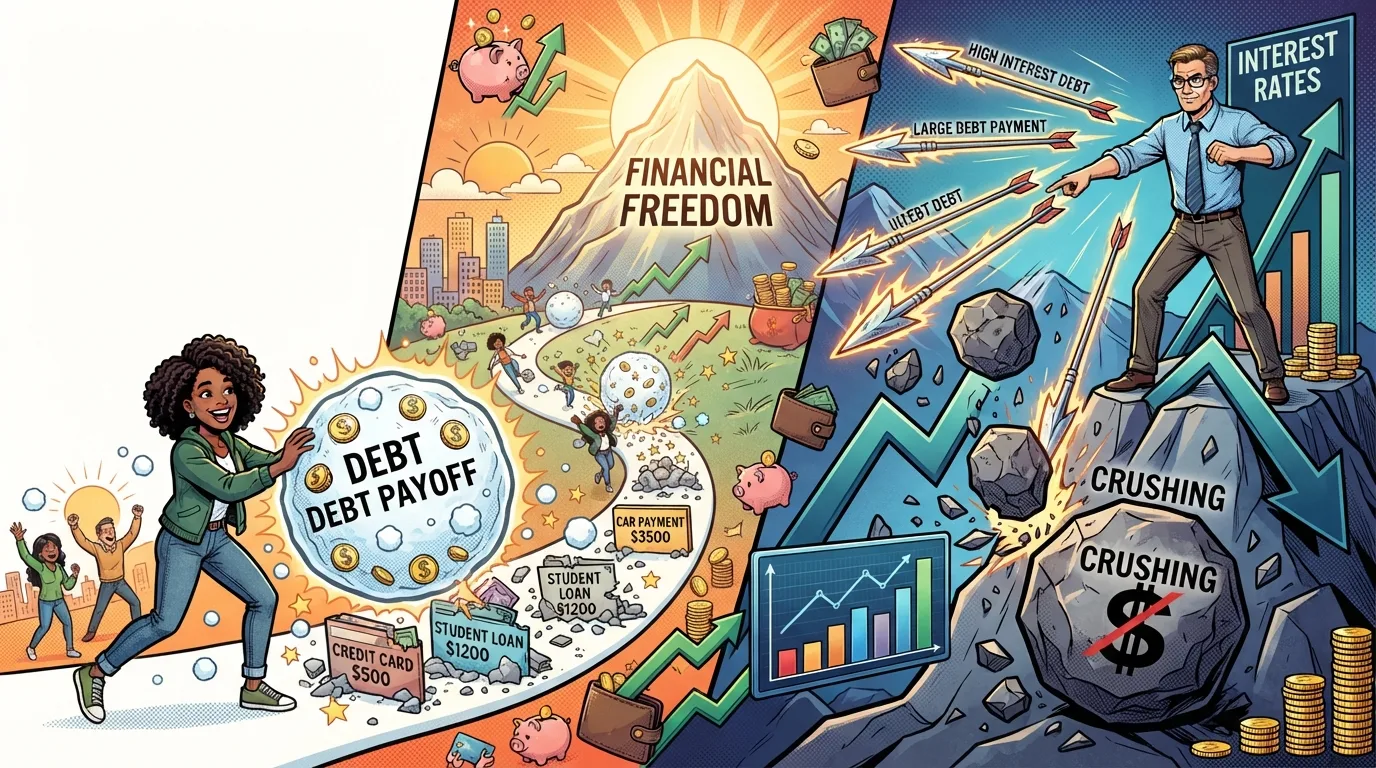
The debt snowball method, popularized by financial author Dave Ramsey, asks you to list all your debts from the smallest balance to the largest, regardless of interest rate. You make the minimum payment on every debt except the smallest one, which you attack with every spare dollar. Once that smallest debt is paid off, you roll its minimum payment plus your extra payment into the next-smallest balance. The payment grows like a snowball as each account is eliminated.
Let's say you owe $500 on a store card, $2,500 on a personal loan, and $9,000 on a car loan. If you can free up $250 per month, you put that $250 toward the $500 store card. In about two months, that card is zero. The sense of accomplishment is immediate, and you're fired up to tackle the personal loan next. You now throw $250 plus the card's minimum payment (say $25) at the personal loan—$275 per month. That psychological boost is why many people choose the snowball method.
The trade-off is financial: because you ignore interest rates, you may pay more in total interest. For example, if the $500 store card had 0% interest but the $9,000 car loan had 9% interest, you'd be paying off a free loan instead of an expensive one. Still, for people who struggle with motivation, the snowball's early wins can make the difference between success and giving up.
What Is the Debt Avalanche Method?
The debt avalanche method is the mathematical alternative. You list your debts by annual percentage rate (APR) from highest to lowest. You make minimum payments on everything and send any extra cash to the account with the highest APR. Once that balance is gone, you move the full amount to the next highest APR, and so on.
Using the same example, suppose the $500 store card has 24% APR, the $2,500 personal loan has 11% APR, and the $9,000 car loan has 6% APR. The avalanche method would target the store card first because 24% is the highest rate. After that's paid, you focus on the personal loan at 11%, and finally the car loan at 6%.
The avalanche is guaranteed to reduce the total interest you pay compared with snowball, assuming you keep monthly payments constant. It also tends to get you out of debt faster, because high-rate balances are costly and slow you down if left alone. The main drawback: your first paid-off account may take many months, especially if the highest-APR debt is also your largest. If the only high-rate debt is a $20,000 credit card, you may not see a visible win for a year or more. That delayed gratification can zap your motivation.
A Realistic Example: Snowball vs. Avalanche
To see why the avalanche usually costs less, consider four real debts:
| Debt | Balance | APR | Minimum Payment | |---|---|---|---| | Credit Card A | $1,500 | 22% | $45 | | Medical Bill | $3,000 | 0% | $50 | | Personal Loan | $5,000 | 10% | $120 | | Auto Loan | $10,000 | 6% | $200 |
Assume you have an extra $100 per month beyond the minimums.
- Snowball order: $1,500 → $3,000 → $5,000 → $10,000.
- Avalanche order: $1,500 (22%) → $5,000 (10%) → $10,000 (6%) → $3,000 (0%).
In this case, both methods start with the same debt, but they diverge immediately after. The snowball would pay off the 0% medical bill before the higher-rate personal loan, costing you extra interest. A rule of thumb: the wider the APR spread, the more the avalanche wins. Here, the avalanche will likely save you $200 to $400 in interest and shave two to four months off your payoff timeline, depending on how quickly you increase payments.
This doesn't mean the snowball is wrong. The exact difference in total interest is the price you pay for the motivational boost. You can use a free online debt payoff calculator to see the dollar difference for your own balances and rates.
Key Differences at a Glance
- Payment priority: Snowball = smallest balance first; Avalanche = highest APR first.
- Primary benefit: Snowball = quick psychological wins; Avalanche = lower interest costs and faster debt-free date.
- Total interest paid: Avalanche almost always wins; snowball can be significantly more expensive if high-rate balances are large.
- Motivation pattern: Snowball gives regular, small successes; avalanche starts slowly and gains speed near the end.
- Best for: Snowball suits people who need emotional reinforcement; avalanche suits people who can stick to a plan using spreadsheets and numbers.
How to Choose the Best Method for Your Situation
Your decision should come down to three factors: your personality, the interest rate gap, and your income stability.
- If you need motivation, start with snowball. Research on behavioral economics suggests that breaking a big goal into smaller milestones increases follow-through. If you have many small debts, snowball creates a quick reward system.
- If the APR gap is large, choose avalanche. When credit card balances carry double-digit APRs and other debts are under 5%, the avalanche will save you a meaningful amount of money. A 15–20 percentage point gap can mean thousands of dollars in interest.
- If your income is irregular, think about cash flow. Avalanche can reduce your monthly interest charges faster, which can free up cash if you hit a tough month. Snowball may not lower expenses as quickly because it doesn't target costly debts first.
Remember: the best method is the one you'll keep using. If snowball helps you budget and stay motivated, the extra interest can be thought of as a fee for a behavior change that gets you out of debt. If you trust yourself to stay disciplined, avalanche is the logical choice.
Can You Combine Both Methods?
Yes. Many people use a hybrid approach to get the best of both worlds. Start with the snowball to eliminate one or two small balances—these wins give you momentum. Then switch to the avalanche for the larger, higher-APR debts that remain. This strategy is especially useful when you have a small debt with a 0% promotional APR and a large debt with 20% APR; you can quickly kill the small one and then attack the large one.
Another hybrid tactic is to use any windfall—tax refund, work bonus, or gift—to make one extra payment on your highest-APR debt while still following the snowball order for monthly extra payments. That way, you chip away at the most expensive balance without slowing your snowball momentum.
Bottom Line
The debt snowball and debt avalanche are both legitimate strategies that share a core principle: make minimum payments everywhere and focus extra cash on one account at a time. The avalanche is mathematically superior, saving you money and potentially months of payments. The snowball is behaviorally superior, offering the quick wins that help many people stay motivated. Your personality and financial tolerance for interest costs should guide your choice. No matter which method you select, the real win comes from making consistent payments and staying the course until every balance is zero. Set a budget, track your progress, and celebrate each account you close—because getting out of debt is a marathon, not a sprint.
Frequently Asked Questions
Which debt payoff method saves more money?
The avalanche method saves more money because it targets the highest-APR debt first, reducing total interest charges and shortening your payoff timeline. The snowball method can cost more, but it may be worth it if it keeps you motivated long enough to finish.
Is the debt snowball or avalanche better for your credit score?
Both methods can improve your credit score by lowering your credit utilization and building a record of on-time payments. The snowball method may close small accounts sooner, which is often a positive, but the overall credit impact is similar for both strategies.
Can I switch between debt snowball and avalanche while paying off debt?
Yes. You can start with the snowball to gain momentum and then transition to the avalanche for the remaining balances. The important thing is to choose a plan you can stick with and avoid taking on new debt while you're paying down old balances.
References